

This post was originally published on this site.
Matt MurphyBBC Verify

 BBC
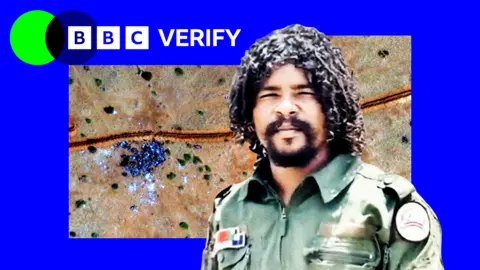
BBCA Sudanese paramilitary commander, whose role in the el-Fasher massacre was revealed by BBC Verify, has been sanctioned by the UK government.
Brig Gen Al-Fateh Abdullah Idris, also known as Abu Lulu, was filmed shooting dead at least 10 unarmed captives after the Rapid Support Forces (RSF) seized the city in late October.
Thousands of people are believed to have been killed by the RSF after the army withdrew from el-Fasher. UK Foreign Secretary Yvette Cooper said the atrocities taking place in Sudan were “a scar on the conscience of the world” which “cannot, and will not, go unpunished.”
The UK has also sanctioned three other RSF commanders, including deputy head Abdul Rahim Hamdan Dagalo.
Dagalo, who was also placed under EU sanctions in November, was shown in verified footage touring an army base in the city in the hours after el-Fasher fell. He is the brother of RSF chief Mohamed “Hemedti” Dagalo.
Sudan’s civil war – sparked after the RSF and the military’s fragile ruling coalition collapsed – has now raged for more than two years, killing hundreds of thousands of people and displacing millions more.
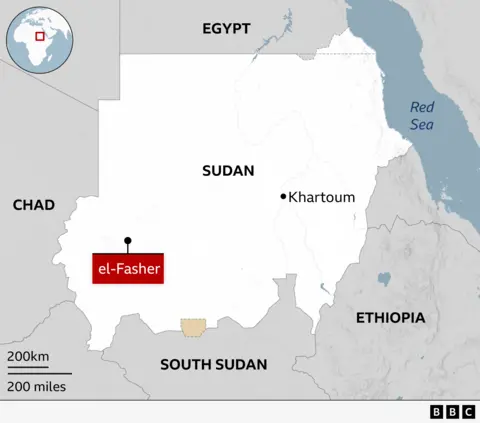
El-Fasher was the army’s last major stronghold in Darfur, the traditional stronghold of the RSF paramilitary.
An investigation by BBC Verify revealed the brutal tactics used by the RSF during the protracted siege, which included detaining and torturing people trying to smuggle supplies into the city and building a massive sand barrier around it to prevent civilians and army troops from escaping.
In its statement announcing the sanctions, the UK foreign office said it believed that Abu Lulu was “responsible for violence against individuals based on ethnicity and religion, and the deliberate targeting of civilians”.
Footage confirmed by BBC Verify in October showed Abu Lulu executing several unarmed captives with an AK-style rifle in a sandy, dusty area north-west of the city. RSF troops who witnessed the incidents were later seen celebrating their commander’s actions.
UK officials accused Abu Lulu, Dagalo, Gedo Hamdan Ahmed and Tijani Ibrahim Moussa Mohamed of carrying out “heinous” acts of violence, including mass killings, systematic sexual violence and deliberate attacks on civilians. The men have been placed under travel bans and any assets they hold will be frozen.
“Today’s sanctions against RSF commanders strike directly at those with blood on their hands, while our strengthened aid package will deliver lifesaving support to those suffering,” Cooper said.
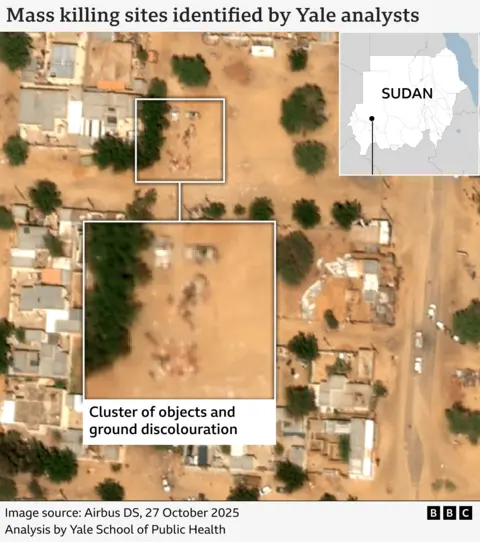
Citing satellite images – previously published by Yale University’s Humanitarian Research Lab – the foreign office said piles of bodies and mass graves could be seen in el-Fasher after the massacre.
Cooper also pledged an additional £21m to provide food, shelter and health services for civilians impacted by fighting in remote areas.
In the days that followed the el-Fasher massacre, RSF leader Gen Mohamed “Hemedti” Dagalo admitted that his troops had committed “violations” and said the incidents would be investigated.
Among those arrested was Abu Lulu. In a carefully choreographed and edited video posted on the RSF’s official Telegram account he is shown being led into a cell at a prison, which was geolocated by BBC Verify to the outskirts of el-Fasher.
The commander, who previously featured heavily in propaganda videos posted online, has not been seen since his arrest. A TikTok account that documented his activities was removed by the company in October after BBC Verify approached the tech giant for comment.
The UK’s move comes just two days after the US announced its own set of sanctions against a network of companies and individuals it accused of recruiting former Colombian soldiers and training individuals to fight in Sudan’s civil war.
The US Treasury Department said that hundreds of Colombian mercenaries have travelled to Sudan since 2024, including to serve as infantry and drone pilots for the RSF.
Last month, US President Donald Trump pledged to “start working on Sudan” alongside Egypt, Saudi Arabia and the UAE, posting on social media that “tremendous atrocities” were taking place.