


This post was originally published on this site.
Sima KotechaSenior UK correspondent

Changing attitudes among boys and young men will be at the centre of the government’s strategy to tackle violence against women and girls, the BBC has been told.
Next Thursday, Home Secretary Shabana Mahmood will unveil the long-delayed plan about how to combat what ministers call a “national emergency”.
It comes after the publication of the strategy has been delayed three times over the last year.
The Labour government has pledged to halve the rate of violence against women and girls over the next decade – but critics have questioned its commitment to combating the problem.
There are also likely to be concerns as to why the strategy is being published on the day Parliament breaks up for its Christmas holiday.
BBC News has been told the violence against women and girls (VAWG) strategy will be built around three goals: preventing radicalisation of young men, stopping abusers, and supporting victims.
Over the coming week, the government will announce a policy blitz to tackle what government sources have called “the scourge of violence that has left the lives of women and girls shattered”.
As part of the strategy, ministers will focus on prevention and tackling the root causes of radicalisation of young men in their schools, homes and online. They will work with teachers to challenge misogyny and promote healthy relationships.
Government sources say more support will be provided to parents so they can intervene early.
They say that is because violence against women and girls is happening at younger ages. Nearly 40% of teenagers in relationships are victims of abuse, according to domestic abuse charity Reducing the Risk.
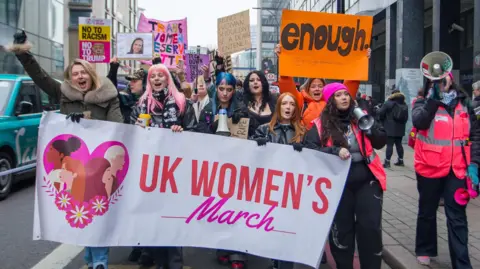
Online influencers are partly blamed for fuelling this. It’s been reported more than one in five young men hold a positive view of the self-proclaimed misogynist Andrew Tate.
Over the last year alone, one in every eight women was a victim of domestic abuse, sexual assault or stalking, according to Home Office figures.
The statistics also show that every day about 200 rapes are recorded by the police, and many more go unreported. Hundreds of thousands of children are estimated to be sexually abused every year.
Earlier this week, MPs on the justice committee wrote to the government complaining about the strategy being delayed.
The letter was signed by the committee’s chair, Andy Slaughter MP, who said: “Repeated delays in publications sends the message that tackling VAWG is not a government priority, despite the ambition to halve VAWG within the next decade.”
The strategy will have a cross-government approach including collaboration between the Home Office, Department of Health and Social Care, Ministry of Justice, Department for Education, and Department for Science, Innovation and Technology, the BBC was told.
“There will also be a raft of new measures, so rapists and sex offenders have nowhere to hide. We will track down abusers, empower police forces with the tools they need to do so and put abusers on a course to stop their offending”, a government source said.
But it is not yet clear what these tools will be.
‘Proof in the pudding’
Hayley Johns is a survivor of domestic abuse and said the “proof will be in the pudding”.
“If you’re going to be saying all these words, make sure it works. We’re in absolute crisis when it comes to domestic violence. The actions must match your words otherwise it’s pointless.
“There needs to be proof and statistics to show this strategy is working and in a year’s time there needs to be a difference otherwise it’s just rubbish.”
The government also wants to support victims who say failures by police and delays in court are worse than the offences themselves. More than half of rape and stalking cases collapse because victims drop out of the process.
Many victims feel intimidated in their own homes and by economic abuse and coercive controlling behaviour, including stalking.
The strategy will aim to better support them, while justice is done.