
This post was originally published on this site.
Mary McCoolBBC Scotland

 Adrian Hunt
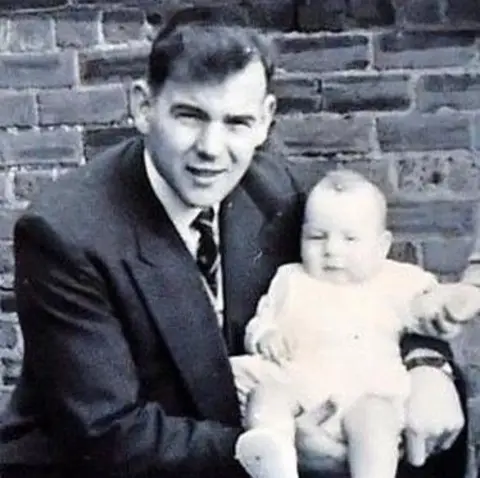
The family of a police detective who was murdered more than 40 years ago while protecting fellow officers are urging the UK government to formally recognise his bravery.
Ross Hunt, a detective sergeant in the CID, was attempting to catch a violent knife criminal when he was attacked by three members of the same family in a South Lanarkshire housing estate in June 1983.
He was pinned to the ground, beaten with poles and stabbed repeatedly while warning his junior colleagues to retreat to their police cars.
DS Hunt’s family have tried to have him honoured posthumously, but a five-year time bar means their requests for a medal have been repeatedly refused.
They are seeking either the George Medal, the Kings Commendation for Bravery or the Kings Gallantry Medal.
DS Hunt’s son, Adrian Hunt – who was an 18-year-old police cadet at the time of his father’s murder – called the matter “bureaucracy gone mad”.
“My family have gone through the mill over the years,” Mr Hunt said. “There’s this intransigence which I don’t think there has to be.
“If this had been done at the time, it would have been a significant statement for the family.
“A man lived his life, and was then murdered – he was only months from his 30-year service. We’ve got a lot of people here who still remember it.”
‘Frenzied attack’
DS Hunt had been called to an assault in a pub in Larkhall – a teenager, suspected of slashing a man in the back, had fled the scene.
The detective identified the suspect and decided to go to his home to arrest him.
Mr Hunt, 60, told the BBC’s Radio Scotland Breakfast programme how a “whole host” of family members came out of the property armed with poles, knives and sticks and attacked DS Hunt and his three detective constables.
“My father corralled his men back shouting ‘Get back to the car’ and at that point he was overcome by one of the individuals who sat astride him and began stabbing him, kicking him, punching him – one kick even lifted his body into the air according to witnesses.
“It was just a frenzied attack.”
By the time officers were able to get back-up on the scene, DS Hunt was lying badly injured in the street. He was taken to hospital, but his son believes he was dead on arrival.
DS Hunt, aged 56, was nine months away from retirement.
Following a trial at the Glasgow High Court, three members of the family – two men and a woman – were convicted of his murder.
The family saw DS Hunt’s body lying in an operating theatre in the aftermath of the attack – Mr Hunt described his father as “stabbed, bruised, beaten and swollen”.
It was a brutal and traumatic experience that would leave an indelible mark on the family for years to come. At the time, they did not request a posthumous honour.
In fact Mr Hunt, who went on to become a police sergeant like his father, says he was told by police senior management that the death did not merit a bravery award.
“For a few years following his death we really couldn’t discuss it,” Mr Hunt said.
“We were relatively young and trying to move forward with our own lives, but we were still dealing with this legacy.
“We had no way of understanding the protocols at the time, especially way back then.”
 Adrian Hunt
Mr Hunt says he and his brothers were only able to contemplate the possibility of a medal when their mother Marjory died in 2013, aged 79.
Despite multiple requests, as well as letters to previous foreign and home secretaries, the Hunt family have been refused any bravery award.
The UK government’s Cabinet Office are responsible for granting honours, decorations and medals through a series of committees.
But those committees do not consider applications for incidents that took place more than five years ago because of a policy introduced after the Second World War.
They were most recently turned down in October when Mr Hunt wrote again to Downing Street.
But their efforts continue, as they run a joint campaign with the family of George Taylor – another officer murdered in the line of duty – to have the rule changed.
In 2023 Police Scotland issued their own Chief Constable’s Bravery Award to DS Hunt, which was accepted by Mr Hunt and his brother.
 Adrian Hunt
At the time Mr Livingstone credited DS Hunt for saving the lives of his fellow officers, and for demonstrating “selfless courage and public service”.
The Lanarkshire Police Historical Society have also taken up the campaign to have DS Hunt’s “selfless actions” recognised nationally.
Mr Hunt believes that ultimately, the UK government policy is outdated.
“It just takes someone to grab this by the scruff of the neck and deal with this in the manner that it should be,” he said.
“As a family, we will never fully realise complete closure but we will take a real comfort and be immensely proud that my father’s legacy is properly recognised by the state and will live on in perpetuity.”
The UK government said the five-year time bar on awards was an “important principle to ensure that awards are timely and clearly linked to specific activities”.