

This post was originally published on this site.
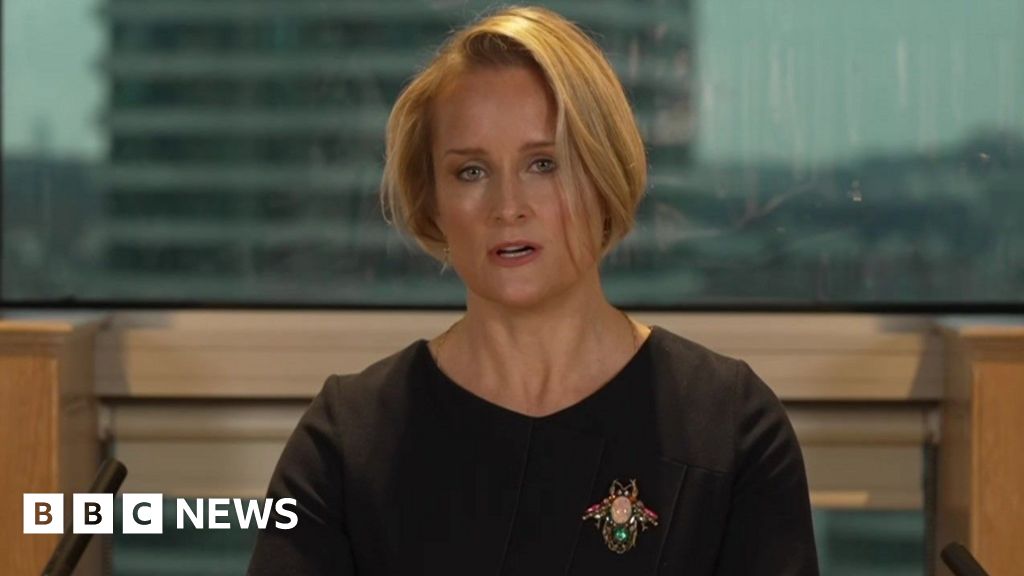
The new MI6 chief has said “we are now operating in a space between peace and war” as she laid out the “interlocking web of security challenges” that the service is working to tackle.
Blaise Metreweli’s first public speech since taking the role focused on the multi-faceted threat posed by Russia, which she said was “testing us in the grey zone with tactics that are just below the threshold of war”.
She also highlighted the “the menace of an aggressive, expansionist and revisionist Russia” while referring to the war in Ukraine, insisting the UK would maintain pressure on Russian President Vladimir Putin on Ukraine’s behalf.
Ms Metreweli is the first woman to head Britain’s overseas spy agency.
She took over as head of the Secret Intelligence Service from Sir Richard Moore on 1 October.
Ms Metreweli used her speech on Monday to point to instances of drones appearing over airports and airbases, and cyber-attacks on infrastructure as being among examples of Russia’s so-called hybrid warfare and grey-zone tactics.
“It’s important to understand their attempts to bully, fearmonger and manipulate, because it affects us all,” she said.
Referencing the recent sanctioning of Russian entities accused of conducting information warfare, Ms Metreweli noted: “The export of chaos is a feature not a bug in this Russian approach to international engagement.”
Western sanctions have certainly damaged Russia’s economy, driving its exports eastwards towards China and India.
But they have singularly failed to change Putin’s determination to wage war on Ukraine until it gives in to his demands for territory and, ultimately, loyalty to Moscow.
Meanwhile, Ms Metriweli described “the defining challenge of the 21st century” as “not simply who wields the most powerful technologies, but who guides them with the greatest wisdom”.
“Power itself is becoming more diffuse, more unpredictable as control over these technologies is shifting from states to corporations, and sometimes to individuals,” she said.
Responding to the threat Russia poses would involve infusing technology and an understanding of technology into everything MI6 does, she said, while making clear that a special area of interest is learning new technologies.
Having joined MI6 in 1999, she has arrived at the top job via Q Branch. Named after the fictional MI6 division in Ian Fleming’s spy books, this is the real life, in-house, top secret part of the Secret Intelligence Service that designs the sorts of gadgets and gizmos that enable agents to communicate with their handlers, without being detected and caught.
Ms Metriweli called on all her intelligence officers to master technology, “not just in our labs, but in the field, in our tradecraft…
“We will become as comfortable with lines of [computer] code as we are with human sources, as fluent in Python as we are in multiple languages.”
Python, a programming language, may surprise some as an example to pick, since it has been around for more than three decades. But her point will not be lost on the men and women who have chosen to work in the shadowy world of espionage.
In an age where data is key, where spies can no longer rely on false identities when biometric scanning can unmask them in seconds at borders and checkpoints, MI6 needs to prove that it can still be relevant.