

This post was originally published on this site.
Bushra MohamedBBC World Service

Mahad Mohamud is slowly readjusting to the heat, chaos and tension of Somalia’s capital, Mogadishu, after being deported from the US city of Minneapolis last month just as winter was closing in there.
Somalis know the 36-year-old as Garyaqaan – a word that can be translated as “judge”.
This is the name he uses on TikTok, where he attracted almost half a million followers while he was abroad. Fans praised Mahad for his defence of his clan’s interests – part of Somalia’s lucrative TikTok roasting sub-culture.
But to those running the White House-linked “Rapid Response 47” X account, Mahad was a “criminal illegal scumbag”. In an October post it accused him of being “involved in the kidnapping of French officials” from a hotel in the Somali capital.
Mahad has denied the allegation, saying that he was not in Mogadishu at the time. He was never convicted and the case was dropped.
He says his detention by the US Immigration and Customs Enforcement (ICE) agency was triggered after a rival TikToker leaked his address.
“ICE told me they had two cases against me – one was entering the country illegally and the kidnapping of a French official.”
Mahad said the kidnapping case was handled by the FBI and after questioning, they cleared him.
But that didn’t save him from being deported.
His journey from Somalia to the US started more than a decade ago and first took him to South Africa, where he lived until 2021. But he says he was assaulted by armed men in a xenophobic attack.
He then went to Brazil and made his way north, eventually crossing into the US, without documentation, through the Mexican border.
“When I jumped the fence from Mexico, I was arrested and detained for a month,” Mahad says.
“I was later released with a work permit because my asylum case was active.”
 Andaou via Getty Images
He then made his way to Minneapolis. “I used to work as an Uber driver. I was happy to finally be in the land of dreams. I hoped they would accept me.”
His TikTok career also took off which gave him a steady income as fans sent him gifts as they watched his live streams. It also led to a threat on his life from the Somalia-based Islamist militant group al-Shabab because of his defence of the government.
Part of his asylum case in the US was based on that threat.
Mahad describes in vivid detail the early May morning when immigration agents arrested him this year.
Shortly after he had eaten breakfast, he went to his car thinking he was about to begin another day of Uber driving.
“Boom, they came for me,” he says.
According to Mahad, he was taken on a 30-minute drive to the ICE headquarters serving Minneapolis and its twin city of St Paul, before being transferred on a six-hour journey to Kandiyohi County Jail Prison in Willmar, Minnesota, where he says he spent six months in detention.
He tells the BBC that three of those months were spent waiting for a decision on his asylum case, and the remaining three awaiting deportation. The authorities denied his asylum claim as they rejected the idea that he would be in danger in Somalia.
Mahad says there were brief periods when he was transferred to Arizona, from where deportation fights leave, but he was told on each occasion that logistical arrangements were not ready.
On one of these trips, he was part of a group of 39 detainees, including nationals of Kenya, Ethiopia and Eritrea, in a holding area for people waiting to board deportation flights.
Finally, when it came to his own departure, Mahad says he was put in a tight restraining jacket and travelled on a small plane with seven other deportees and some guards.
The journey first took them to Costa Rica, in Central America, then to Senegal in West Africa, before flying to Kenya’s capital, Nairobi. There Mahad says the restraining jacket was removed and he was handcuffed and put on another plane to Mogadishu.
Having spent three months waiting to be deported, Mahad had already resigned himself to his fate and was not particularly emotional on his return.
After a decade apart, he has finally been reunited with his three children. “I wouldn’t trade this moment for anything now… I haven’t seen them for 10 years,” Mahad says.
But he would still prefer to be in the US because he fears for his life after receiving text messages from al-Shabab, containing death threats.
He takes extra security precautions when he’s out and lives in a well protected home but did not want to go into further details, or share the contents of the threats, for safety reasons.
 Getty Images
On his return, Mahad was welcomed by many people from his clan, including local politicians, because of his TikTok profile. He understands that because of his social media presence he may get opportunities not available to other Somalis deported – or threatened with deportation – from the US.
Last month, President Donald Trump said he would end the temporary protection status that is supposed to prevent people from being deported while their home country is unsafe.
Earlier this month, he upped the ante, saying that he does not want Somali immigrants in the US, telling reporters they should “go back to where they came from” and “their country is no good for a reason”.
Somalia has not had a central government in control of the whole country since the toppling of President Siad Barre in 1991. People have had to endure years of near anarchy and insecurity – and even now, despite a government being in place in Mogadishu, Islamist militants still dominate much of the country and occasionally stage attacks in the capital.
Trump’s comments came after he was questioned about large-scale fraud in the state of Minnesota’s social assistance programme.
Dozens of people have been charged over a scheme that federal prosecutors say involved a charity fraudulently billing the state’s government for meals for children during the Covid-19 pandemic.
A number of Somali immigrants were implicated in that alleged scheme.
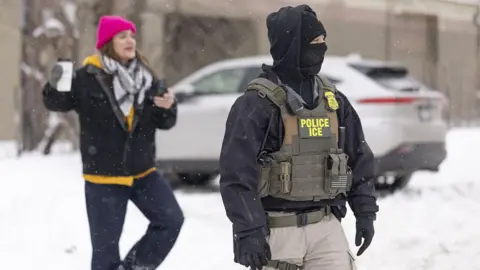
In the wake of the president’s remarks about Somalis, videos have circulated on social media appearing to show immigration agents knocking on doors across Minneapolis, which includes an area known as Little Mogadishu, and St Paul.
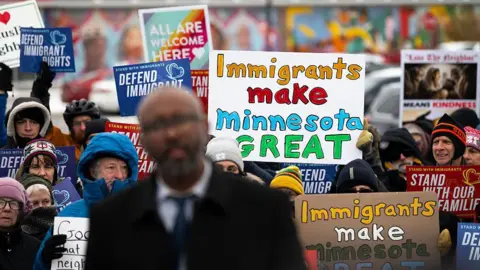
For many in the city’s Somali community, the largest in the US and numbering around 80,000, the posts have triggered alarm.
The BBC also spoke to five young Somali men who now spend their days confined to a friend’s small house, moving carefully through rooms that are not their own. They left their rented apartment abruptly last week not because they wanted to, but because the lease was under their names.
As people who had been given temporary protected status, they feared it was only a matter of time before ICE traced the address and came for them. They grabbed what they could carry and slipped away in the night, hoping the change of location would offer some protection.
Now, their lives are suspended. Work shifts are missed. Meals are skipped or stretched. One of the men described how quickly everything has collapsed: “We’re running out of food. We haven’t reported to work for the past five days because we’re scared that ICE might be waiting for us. I don’t know what will happen to us.”
Mahad is far from being alone in being deported to Somalia in recent months, although there are no official figures.
The BBC also spoke to another young Somali man, who asked to remain anonymous. He said he was struggling to rebuild his life back in Mogadishu.
From rural Somalia, he was desperate to leave as a prolonged drought had destroyed his livelihood. He illegally crossed into the US through the Mexican border after travelling north from Brazil but was detained shortly after. He spent 18 months in custody before being returned to Somalia.
Speaking on the phone, he describes feeling uncertain about his future.
“They sent me back to start from zero,” he says. “Everything I worked for just disappeared.”
He says he spent around $20,000 (£15,000) to reach the US, including money he had borrowed from friends and family.
Since returning home, he has had no money and says there are no opportunities in Somalia.
“I don’t see a future here,” he says. “There is nothing going on… no employment.”
He is now considering migrating once more.
“I don’t want to start life again. I just want to migrate to any country now.”
 Getty Images/BBC