
This post was originally published on this site.
It takes a lot for cricketers to be left starstruck by other cricketers.
It is the morning of the second day of the second Ashes Test. John Aiken is chatting in the courtyard of a Brisbane hotel when he is spotted by two former England spinners – Phil Tufnell and Alex Hartley.
Tuffers asks for a video to send to his wife and her friends. Hartley gets a selfie to put in the girls’ WhatsApp group.
All standard stuff. As a relationship expert on Married at First Sight Australia (MAFS), Aiken is one of the most recognisable TV personalities in the country. If you’ve not seen it, the show does exactly what it says on the tin – strangers are matched then meet at the moment their wedding begins.
There are numerous versions, including in the UK, but it is the Australian brand that has a cult following across the globe.
But here’s the thing. Neither Tufnell nor Hartley are aware they have just met a former first-class cricketer.
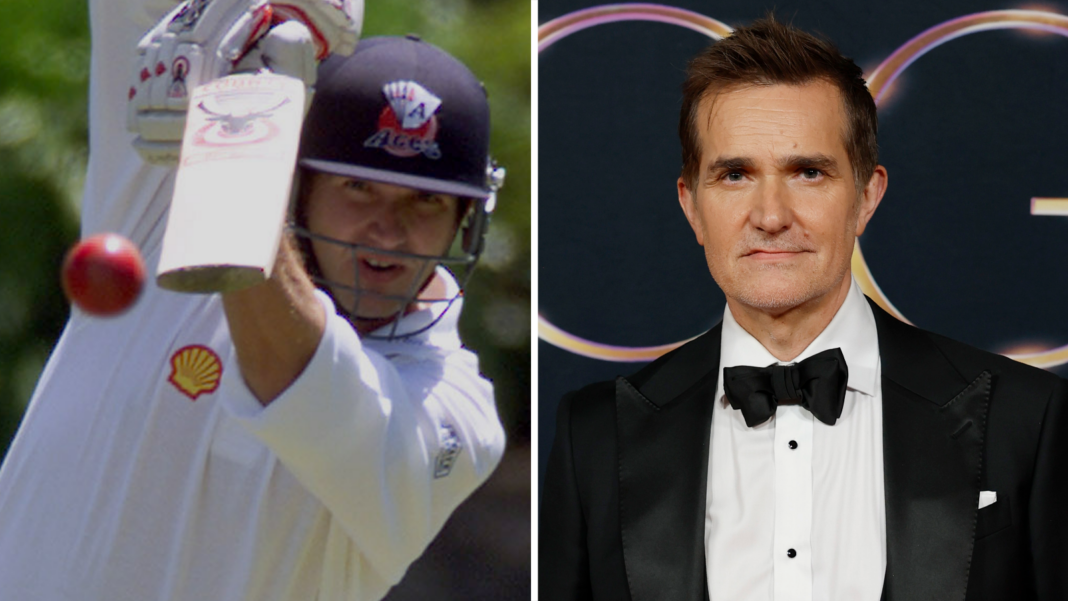
Aiken, a left-handed opening batter, had an 11-year career on the New Zealand domestic scene between 1990 and 2001. His Wikipedia page has the heading “John Aiken (cricketer)”.
“I’ve kept in contact with a lot of the Black Caps that I played with as I was growing up,” Aiken tells BBC Sport.
“I’ve stayed in touch with Mark Richardson, Chris Cairns, Chris Harris and Craig McMillan.
“What’s strange now is they see me as the guy from MAFS, not so much the left-hander who played for Wellington.”
Aiken is now 55. His post-cricket career has made him a household name in Australia. The day before, he was in the crowd at the Gabba and approached by a man in a “pink Hawaiian shirt” wanting to know about the 13th series of Married at First Sight, due to air in the new year.
Almost four decades ago, Aiken was taking his first steps in professional cricket. Born in Sydney, he moved to New Zealand at the age of 12 and made his way through the Wellington system.
In 1989, he was alongside Cairns, Harris and Adam Parore in a New Zealand Under-19s team that toured England to take on a home side including Mark Ramprakash, Dominic Cork and Darren Gough. Aiken even got to taste playing at Lord’s.
“Nick Knight put us to the sword every single time we faced him,” says Aiken.
Six months later, Aiken was making his first-class debut for Wellington. He made 156 not out against Canterbury at the famous Lancaster Park in Christchurch.
“I was a bit more conservative than the likes of Ben Duckett, Michael Slater or Matthew Hayden,” says Aiken. “If I was playing today I’d have to change my game and be more attacking.
“The one thing that held me back was that I would over-analyse pretty much everything. I’d be up at night in front of the mirror, shadow batting, all that sort of thing.”
Aiken combined his early years as a professional cricketer with studying for a master’s degree in clinical and community psychology. Though he graduated at the age of 25 and psychology would eventually become his life, Aiken’s first ambition was to play cricket for New Zealand.
He thinks he got “close”, but never managed the weight of runs to earn a black cap.
Instead, there were brushes with greatness in domestic cricket. New Zealand legends Martin Crowe and Stephen Fleming were team-mates at Wellington and an opponent was left-arm spinner and current Australia assistant coach Daniel Vettori. “He landed it on a handkerchief,” says Aiken.
Aiken regularly played against touring international teams and was run out in a one-day game by South Africa’s Jonty Rhodes, probably the best fielder of all time.
“Any day of the week it was an easy single,” says Aiken. “I hit it into the gap, I said, yes, easy one. He ran me out by half the pitch.”
When Aiken left Wellington to join Auckland, he came up against a West Indies team including the great Brian Lara.
“We had a meeting the night before and we just said: ‘Nobody say anything to Brian Lara,” recalls Aiken. “We greet him as Mr. Lara. We are polite. And if he gets bored, he may get out early. We all know that if you sledge him, he’s likely to get 400.
“So sure enough, he walks out. ‘Hello Mr Lara, how was your stay? How’s it going?’ It was delightful. He must have pumped our opening bowler out of the ground twice, then hit one up in the air and he was out. We all just breathed an immense sigh of collective relief.”
Another opponent was a young wicketkeeper-batter from Otago called Brendon McCullum – now a MAFS watcher, on orders of Australian wife Elissa.
“Anyone from Otago, you’ve got to roll your sleeves up because they’re going to come hard at you,” says Aiken.
“He had a style where he was going to really make a name for himself right from the word go. I don’t know him very well, but he doesn’t seem someone who worries too much about what others have to say.”
By the age of 30, Aiken realised the dream of international cricket was fading. After a season playing club cricket in the UK for Yorkshire side Gomersal, he called time on his playing career.
He registered a pair in his final first-class match, in February 2001. Aiken ended with four hundreds in 46 first-class matches, averaging just under 29. He made another ton in 39 List A matches.
Seven years later, Aiken moved back to Australia and set up his own private practice “seeing couples, singles, and minding my own business”. He had dabbled in some slots as a relationship expert in daytime TV, but it was an email he received in 2014 that would change his life.
Aiken was invited to audition for Married at First Sight and got the role. More than 11 years on, the show will air its 13th series in Australia in January and will follow in the UK in the spring. It is an Australian phenomenon, probably behind only children’s cartoon Bluey as the current biggest TV export from this country.
The fascination of the show is not only whether two strangers can fall in love, but also the interactions of 12 different couples – usually with fiery consequences.
“It is unscripted, it is real and it is authentic, and you don’t know what they’re going to do,” says Aiken.
It is Aiken’s role to guide the couples and “hold them to account”. The tongue-lashings he delivers are up there with the most entertaining parts of the show. Quite a character swerve from the opening batter who over-analysed himself in front of the mirror.
“I’m not inside my head when I’m in MAFS and doing my role,” says Aiken. “When I was playing cricket I was inside my head.
“Over-analysing things generally slows you down and in cricket, if you’re thinking about your technique all the time, I found that it would ultimately lead you to getting out and feeling insecure about your game.
“TV is about getting there and just dealing with whatever’s in front of you, call it out and just roll with it. I feel like I’m much more relaxed in the world of media than I was when I was playing cricket.”
In terms of his two distinct careers, Aiken says the “excitement” of Married at First Sight has the edge over the “anxiety” of opening the batting, and he would not exchange his place on the MAFS couch for a coveted New Zealand black cap.
“Cricket gave me some great moments, but I wasn’t able to flourish, to sit back and enjoy the ride,” says Aiken.
“On Married at First Sight that’s all that I do. MAFS is something that just has given me such joy.
“And you know what? It can work. Strangers can fall in love. This year we have some love among the chaos.”