

This post was originally published on this site.
Alex Taylor

 Getty Images
Christmas is billed as the most wonderful time of the year – but the day itself could have all the ingredients needed for a family row.
There’s a reason you haven’t seen some of these people all year – you just know someone is going to criticise your cooking, there will be a heated debate over dinner and a tussle over the TV remote.
We spoke to psychologists and parenting experts for their top tips on how to keep the Christmas spirit and avoid a family fallout.
1. Give up on the perfect Christmas
 Getty Images
Begin by refusing to chase the idealised movie version of Christmas, says psychotherapist and author Philippa Perry.
“We need to lower the expectations of what Christmas gives us, and then we won’t be so disappointed in it,” she told CBeebies’ Parenting Helpline podcast.
Unspoken rules like “we must see everybody” only add to the stress, as does social media pressure over what the picture-perfect Christmas Day should look like.
Natalie Costa, a parenting coach, former teacher and host of the Connected podcast, encourages people to remember that nobody’s life looks the way it does online. “Behind all the happy family pictures are children – and adults – who’ve had big meltdowns,” she says.
This reality check can help reduce guilt over not measuring up.
Instead of trying to compete with others, she suggests approaching Christmas with the attitude of: “What does my good-enough look like?”
2. Don’t compete on gifting
Exchanging presents is a huge part of Christmas. If there are young kids in the house, giddy early wake-up calls are a given.
But sometimes gift-giving can feel competitive, especially among extended family where budgets can differ, says Prof Perry.
The best way to handle this isn’t to try to compete or police kids’ relationships with adults, but reframe the situation.
She encourages parents to “let go” if grandparents, aunties and uncles choose to spoil young ones.
Costa adds that this can later become a useful way to discuss values with children – emphasising that bigger presents don’t reflect love.
“You cannot buy love,” Prof Perry says. “What children like is your attention and being played with. That is better than any gift.”
3. Prepare for awkward comments
 Getty Images
Complicated family dynamics don’t disappear just because it’s Christmas and festive classics are playing.
One minute you’re merrily drinking mulled wine, the next being asked why you’re not happily married or whether you are planning children.
Any resentments, tensions and difference in values will remain with the added pressure of fulfilling a fantasy image of happy families.
Passive aggressive comments often come from someone else’s stress and insecurity, says psychotherapist Sarah Turner. This doesn’t excuse the behaviour, but can make it feel less personal.
When we feel stung our instinct is to defend or withdraw, but Turner advises pausing first. “You have the power to choose how to respond.”
Another tip is to ask for clarification. Often loved ones will reframe what they said rather than repeat it – as they are likely to know it’s a loaded comment.
If there’s a “kernel of truth” in what they say, then acknowledging this can help “emotions de-escalate because they feel heard,” Turner adds.
This doesn’t mean you agree or give in – it’s simply letting that person know you understand where they’re coming from. In the heat of family dynamics, this can make all the difference.
3. Make it clear who’s in charge
 Getty Images
Children are naturally excited on Christmas day – but that burst of energy often means big exhausted emotions later on, tantrums and tears included.
To prevent other family members stepping in to try and manage this, Costa suggests having a simple conversation beforehand to establish the rules.
She advises something like: “I know it [how we parent] may be different to what you did… What helps us most is keeping things consistent, so if anything comes up, leave it with us.”
Have a few simple non-negotiables, such as screen-time limits and any essential safety boundaries.
Some families also find it useful to have something light-hearted to ease the pressure, explains Costa. One used the codeword “smelly bananas” to signal things were getting too much.
Whoever’s home you’ll be visiting, managing expectations is crucial. Let children know who will be there, what the day will look like, and what they can do if they start to feel overloaded.
4. Don’t comment on food choices
 Getty Images
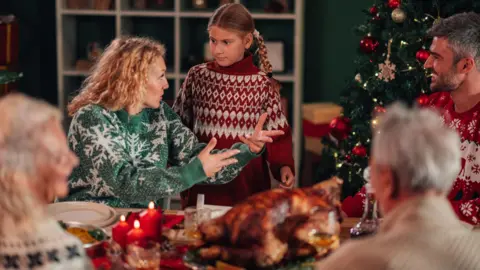
Christmas dinner often includes foods such as brussel sprouts, red cabbage and turkey which we rarely eat the rest of the year.
Some adults and many children simply don’t enjoy these foods.
What we call “fussiness” with a disapproving tone, is often anxiety and sensitivity, says consultant counselling psychologist Dr Ritika Suk Birah. The key to an enjoyable meal is to remove the emotional charge.
Offer a few predictable options, normalise different preferences, and don’t turn food into a moral issue.
“For adults, autonomy is essential, provide alternatives without commentary,” she says.
For children, who may be facing things like sprouts for the first time – a “safe plate” alongside festive foods works well, something familiar that grounds them so they can explore new foods at their own pace.
Agree a TV plan beforehand
 Getty Images
TV can be central to Christmas family time, often when stuffed full of food and slightly sozzled.
But disagreements over what to watch are common.
Older relatives often want shared traditions; younger people want autonomy and novelty, especially in the YouTube age.
The best approach is to decide the viewing plan before emotions are high, says Dr Birah. Agree on a simple rotation: one shared programme, one independent choice and a set period where screens are put away.
If the idea of watching “old people TV” is causing trouble with your teens, acknowledge their perspective, says Costa.
Something like: “I get it. YouTube is exciting and fun, and you really enjoy it.”
Then explain what else is happening: “Right now we are spending time together as a family. This part matters too.”