
This post was originally published on this site.
Rugby correspondent Steffan Thomas sits down with Welsh rugby royalty Derek Quinnell
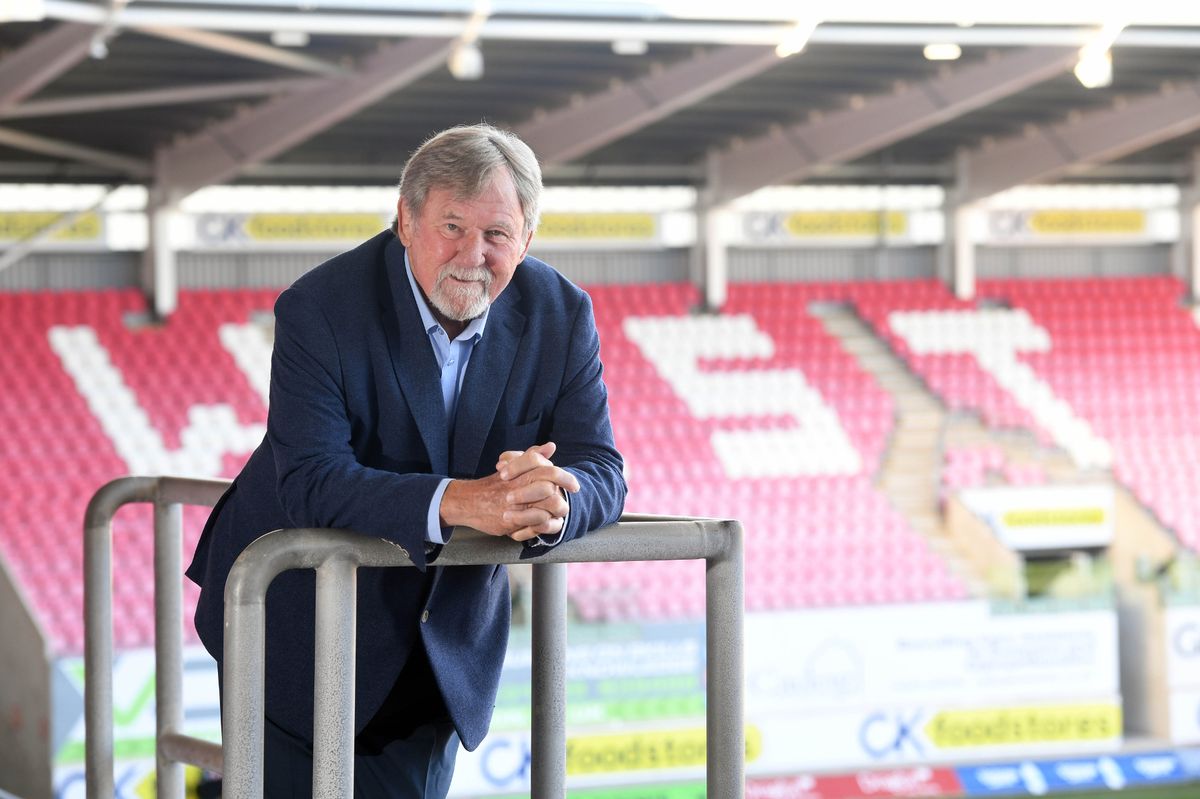
There are few rugby players more celebrated in west Wales than Derek Quinnell.
The 76-year-old has an affinity with the Scarlets which stretches back more than 60 years when he was a young child sitting on the shoulders of his grandfather on the Tanner Bank at the legendary Stradey Park.
Quinnell first represented Llanelli RFC back in 1967 and played in that most celebrated day on Halloween 1972 when the Scarlets beat the All Blacks.
The thought of the Scarlets disappearing from Welsh rugby’s landscape does not bear thinking about for Quinnell but the club is in a fight for its survival.
As part of the Welsh Rugby Union’s attempt to restructure the professional game it is planning to reduce the number of teams from four to three with one in Cardiff, one in the east and just one in the west.
It does not take a genius to work out one of the Ospreys or Scarlets are in the firing line.
Quinnell’s playing days are long behind him but he still retains an important role as Scarlets president following in the footsteps of Ray Gravell and Phil Bennett, two fabled figures in Welsh rugby folklore.
He feels a great responsibility as a Scarlets board member to ensure the club survives.
“I don’t envy the players and the staff who are here or in any other region who are staring down the barrel of potentially losing their jobs,” he tells WalesOnline.
“It’s a horrible time for Welsh rugby in that respect but when you look at the facilities we have here at Parc y Scarlets they are magnificent.
“This is a ground which holds 15,000 and we can get 800 people in here for hospitality.
“When the pandemic was on this operated as a field hospital as well.
“It also contributes to Carmarthenshire County Council.
“They use the facility to a great extent. So, what we have here is without doubt the best professional club operation in Wales.
“When you look at it compared to the other three there is no comparison.
“When you look at the facilities we have here at Parc y Scarlets I would hope it would reinforce that there has to be a professional side in Llanelli.
“I can’t see an argument strong enough from anywhere else for any of the other three regions.
“When you look at it overall I’m confident we have the facilities to start with along with the knowledge and knowhow of our board of directors that has made sure the way forward for this region hasn’t been hampered by a lack of funding.
“We’ve kept everything afloat and everything going, unlike some other regions who haven’t been able to do it.
“It’s now up to the union as to how they see things going forward but the expertise we have here and the region that we cover in my mind it is a no-brainer.”
Quinnell’s love of Welsh rugby is not purely confined to the Scarlets but the whole of the game in Wales.
The former lock won 23 caps for Wales during the halcyon days of the 1970s and was a member of three British & Irish Lions tours, including the legendary 1971 victory over the All Blacks which remains the only time they have ever won a Test series in New Zealand.
Quinnell also coached Wales for three seasons in the late 1980s alongside Tony Gray and was a selector on three Lions tours.
It is safe to say Quinnell knows his stuff and he has warned the WRU they simply cannot afford to get the new structure wrong.
It is close to the point of no return and the next move will be decisive one way or the other.
“They have to get it right this time,” Quinnell tells WalesOnline.
“We’ve been here before when we went down to four regions. That was supposed to cure all ills but we haven’t got it right. So, we’ve got to look at a blueprint to make sure we have a pathway which is right for the young people who are starting to play the game.
“We need to make sure they can aspire to be in their regional side and national side.
“We have to give them that ambition and look after them properly so we can be in a position where we can compete both regionally and internationally.
“We recognise there has to be change because when we look at our international and regional record of late it hasn’t been good enough.
“Finance is the main thing to get us back to where we should be.
“If we can be financially better off that is important but it is also important the board of directors we have here now have a big input into the way the professional game is run because we have a lot of expertise on the board.
“We believe we can make a big contribution to professional rugby in Wales. Hopefully the Scarlets can lead the way forward.”
Quinnell has contributed so much to the game in Wales and is also the father of one of world rugby’s greatest dynasties.
The 76-year-old’s sons, Scott and Craig, also played for Wales, while his youngest boy Gavin was the fourth Quinnell to represent the Scarlets before his career was tragically cut short after losing his eye while playing for Llanelli RFC.
His eldest Scott won 52 caps for Wales and went on two Lions tours, while he is widely regarded as one of the most destructive ball- carrying No 8s to have ever played the game.
Craig, who was a gigantic second-row, won 32 caps for his country.
Quinnell senior has recently retired and enjoys life with his five grandchildren and one great grandson.
“I retired on my 76th birthday which was last May,” he says.
“I’ve run a business since 1983 so for 42 years and I actually finished six months ago which takes a little bit of getting used to.
“But it does afford you some time to go around the world on some trips, see old friends and enjoy yourself.
“I used to run a chemical company – a water treatment company.
“I’m very proud of what Scott, Craig and Gav achieved but I never put any pressure on them to play rugby.
“They did the family proud in fairness to them.
“Both Craig and Scott amassed more caps than I did and Gav unfortunately lost his eye in a game that finished his career.
“Gav is doing very well now. He lives about 100 yards away from where we are.
“He’s got two children Osian (9) and Megan (6) who both play for Llanelli Wanderers.
“I’ve got a great grandson who lives in Bristol so I head down to see them often.
“I also see Craig and Scott on a regular basis.”
A chat with Quinnell wouldn’t be complete without a trip down memory lane.
He recalls playing for Llanelli against the Springboks at Stradey Park in 1970 where the Scarlets lost by a point as the moment he realised he could compete with the best.
That famous day when the pubs ran dry in 1972 will forever be etched in his memory, as was the 1971 Lions tour of New Zealand – both under Carwyn James.
“To beat the All Blacks was fantastic,” he said.
“Ever since that day in 1972 the number of people I’ve met who said they were there we must have had about 70,000 people in the crowd because almost everyone I know said they were there.
“On that 1971 Lions tour everyone talks about the backs but there was so much grunt up front and we won the ball for a great set of backs.
“You look at Gareth Edwards and Chico Hopkins at scrum-half, Mike Gibson who was the second fly-half with Barry John but he played in the centre with John Dawes.
“We also had the likes of David Duckham, Gerald Davies, Arthur Lewis and JPR Williams.
“Even the second string backs were very good so the competition for places was strong.
“It certainly brought the best out of the players.
“A lot of the coaches who came through also admired the way the ’71 Lions played so a lot of kudos for Carwyn.
“You’ve got to remember Carwyn was the coach and Doug Smith was the manager.
“We were 32 people with 30 players who left for 26 matches – two in Australia and 24 in New Zealand.
“These days when you go on tour you normally bring 40-odd players.
“In 2005 they took 47 players to play in 10 games which is hugely different.
“If you had to play Saturday, Wednesday and then Saturday again, so be it.”
As a player Quinnell did something rarely seen today, winning a cap for the Lions before Wales.
The epic day when Quinnell forced himself through a crowd of people in the tunnel at the old National Stadium before barging past a couple of burly policemen to win his first cap against Scotland as a replacement for Mervyn Davies in March 1972 is one of Welsh rugby’s most iconic moments.
“I’d sat on the bench about 10 times and back then it was different so I didn’t know whether I’d ever win a cap,” he recalls.
“Not having a cap was something I desperately wanted to put right.
“In those days the doctor had to declare a player unfit to continue in the match and only then you could put a replacement on.
“By the time it came for me to come on there was only a couple of minutes left in the game so I thought ‘oh no I’m going to miss out here because the ref will blow up before I get onto the field’.
“In those days on the subs’ bench you’d have somebody who was in charge of the sweets and it was my turn to be in charge of the sweets that day.
“So, I had a boiled mint in my mouth when the call came and we were actually sitting up in the stand.
“So, I had to run down the stairs and then go to the medical room where Merve was having his examination.
“By the time it was time for me to go on the field I thought oh I’ve still got a mint in my mouth so I spat it out.
“When I got home the following day I was expecting mam and dad to say ‘well done, you got your cap’ but mam gave me a rollicking.
“The first thing she said was you dirty so and so, the first thing you did was spit but I said ‘mam, it was a boiled sweet’.
“It looked bad so I had a bit of a row off mam.”
Quinnell also fondly remembers one of Welsh rugby’s greatest cult heroes Ray Gravell.
“He’s one of these characters where it didn’t make any difference whether you were the president or a janitor he treated everyone the same,” he tells WalesOnline.
“I remember his first international cap in Paris in 1975. Before games he’d be banging walls and hitting everybody saying ‘come on lets get stuck into them.’
“Somebody came in with a telegram in those days and gave it to Grav. When he received it he started crying and said boys listen I’ve got a telegram here that says ‘Pob lwc Ray oddi wrth man and Toddles.”
“We said ‘who the hell is Toodles?’ He went ‘Toodles the cat mun!’
“This was two minutes before running out to play an international.
“Benny gave him the ball on the crash and Grav bowled over the French centre and scored a try.
“That was it he wanted the ball every time and it was impossible to miss him out.
“Him and Geoff Wheel together were a pair because they used to room together for Wales.
“They were an absolute nightmare!
“I remember in Australia in 1978 we had a bit of a get together and we were told what we had to be careful of as there are some snakes that are poisonous and there are some nasty spiders.
“So they were rooming next door to me in a motel. So, I could hear banging coming from his room and thought ‘what the bloody hell is that?’
“I knocked on the door and Grav wouldn’t open so I shouted for him to open the door.
“He said ‘oh no we are going to bed early because we are jet lagged’ even though it was only 6pm.
“Grav mun, it’s only 6pm open the door. What they’d been doing was banging towels by the side of the door to make sure the spiders couldn’t get in.”
The final moments of the conversation are spent reflecting on the rich history of Welsh rugby — and a reminder that, for Quinnell, that history should matter when decisions are made about the future of the professional game.