

This post was originally published on this site.
The rapid spread of the Black Death through medieval Europe could have its origins in a massive volcanic eruption, according to new research.
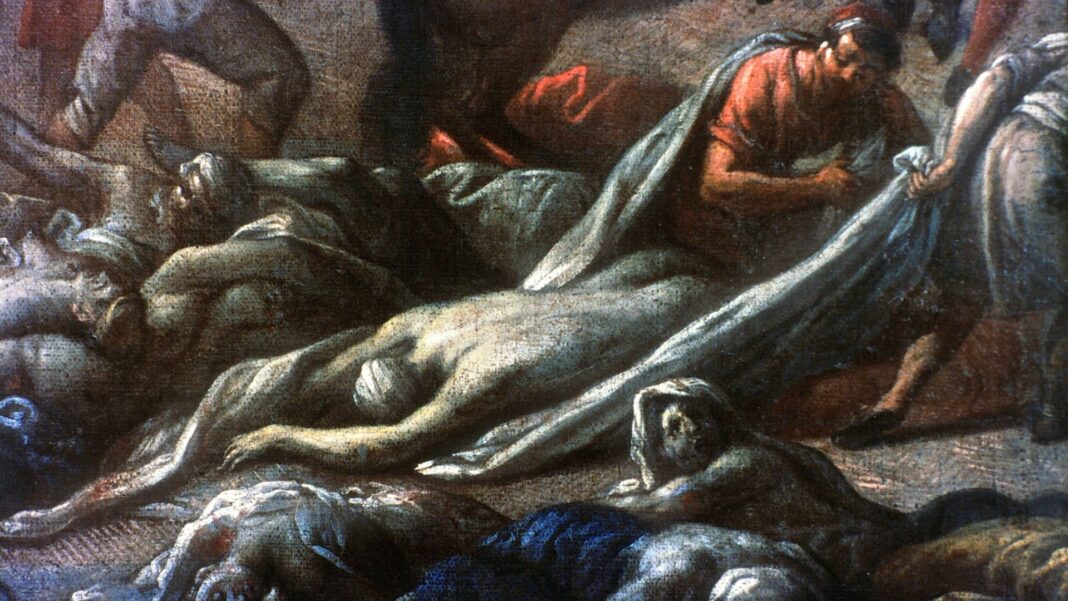
The plague killed between a third and half of the European population in the mid-14th century. But it’s unknown what triggered the pandemic.
Now scientists in Cambridge and Germany have pieced together an extraordinary sequence of events from environmental clues and historical records that they believe solves the mystery.
They say sooty particles trapped deep in the ice sheets of Antarctica and Greenland suggest there was at least one eruption by an as-yet-unknown volcano in the tropics, around the year 1345, that shrouded the planet in a thick haze of ash and sulphur.
That fits with written evidence from the time, which reports unusually cloudy conditions and dark lunar eclipses, according to the study published in the journal Communications Earth & Environment.
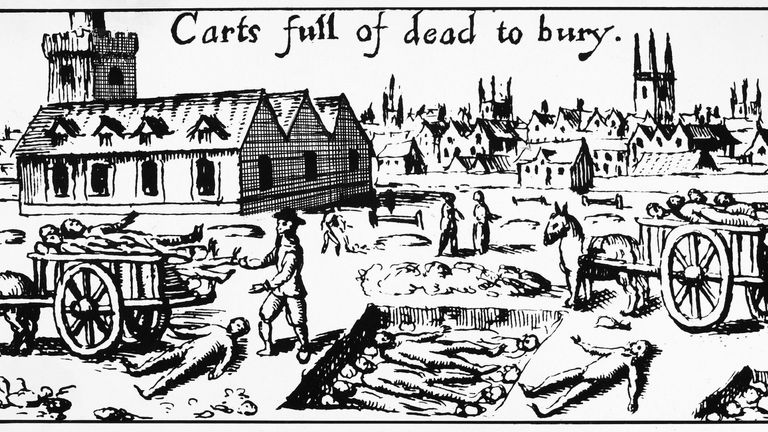
Pic: Granger/Shutterstock
New analysis of tree rings from around the time shows there were three years of stunted growth, suggesting the volcanic haze resulted in cool, wet conditions that would have led to a series of crop failures, according to a team in Cambridge.
Dr Martin Bauch, one of the study authors and a historian of medieval climate and epidemiology at the Leibniz Institute for the History and Culture of Eastern Europe, told Sky News that the eruption’s impact on food supply was the key first stage in the sequence of events building up to the pandemic.
“In the years before the Black Death arrives, there is very unusual weather from England, across the Mediterranean to the Levant,” he said.
“That large-scale pattern can only have a climatic explanation and the volcano is a good one because the impact would last two or three years. It all fits together.”
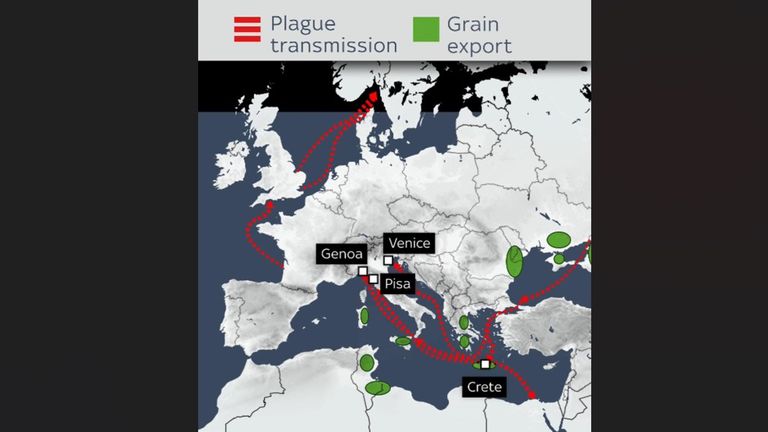
How the plague spread. Source: University of Cambridge / GWZO
The researchers say the subsequent famine explains why the Italian maritime cities of Venice, Genoa and Pisa reached out to the Mongols of the Golden Horde around the Black Sea in 1347 and began to import grain.
Previous research has concluded that ships carrying the grain also brought fleas infected with the plague bacterium Yersinia pestis, most probably from wild gerbils somewhere in central Asia.
Once in Italy, the fleas jumped onto rats and other mammals – and spread devastation around Europe.
“These powerful Italian city states had established long-distance trade routes across the Mediterranean and the Black Sea, allowing them to activate a highly efficient system to prevent starvation,” said Dr Bauch.
“But ultimately, these would inadvertently lead to a far bigger catastrophe.”
Professor Ulf Buentgen from Cambridge University’s Department of Geography, another of the study authors, said the perfect storm of climate, agricultural, societal and economic factors that led to the Black Death were an early example of the consequences of globalisation.
“Although the coincidence of factors that contributed to the Black Death seem rare, the probability of zoonotic diseases (which jump from animals to humans) emerging under climate change and translating into pandemics is likely to increase in a globalised world,” he said.
“This is especially relevant given our recent experiences with Covid-19.”